“Know thyself” — Temple of Apollo at Delphi. Self-report names strengths badly; the corpus names them well.
The move. Before reading any outside literature, reverse engineer the team from its own papers. Instrument: the repertory grid of Kelly's personal construct theory (1955). Grids are elicited by triads — pick three team members, ask which stands apart and on what dimension; each answer is one bipolar construct; repeat until no new dimensions appear; rate everyone on everything.
The LLM twist. Data collection took minutes, not weeks. For six authors, an LLM agent fetched each author's five most-cited papers (all-time and last five years — some 1,200 paper records), coded them against the ICSE'27 research-track areas, then played triad interviewee. Constructs agreeing above 90% merged. FOCUS sorting reorders rows and columns so similar neighbors adjoin, and builds trees by merging adjacent clusters only.
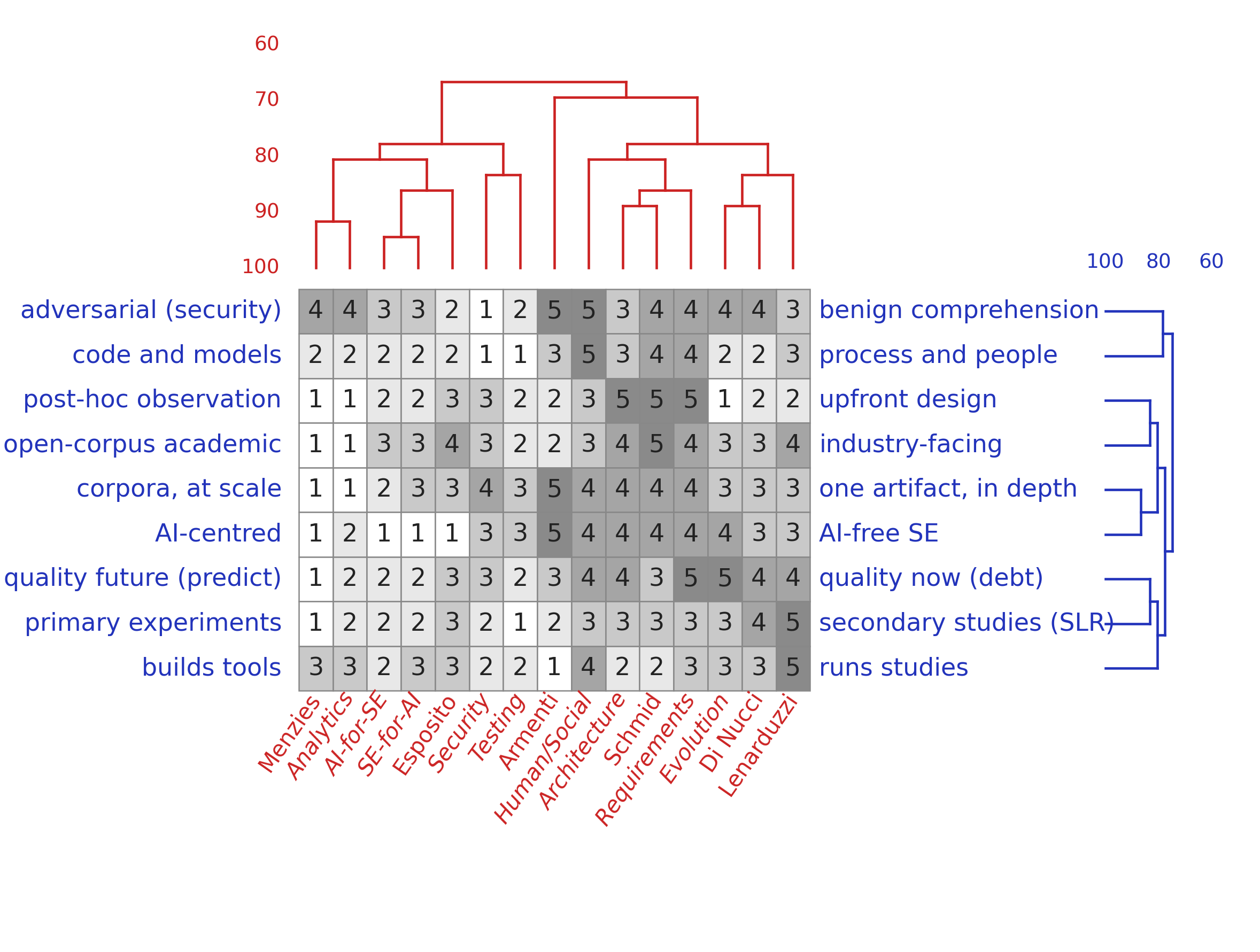
The grid after FOCUS sorting: constructs as rows (left
pole = 1, right pole = 5), authors and ICSE'27 areas as columns, trees
join neighbors by percentage match. Regenerate: make focus.
Three readings of the grid.
Caveats, stated in the open: one rater (the agent), citations as the sole strength proxy, early-career authors rated on few papers.
The knob. Disagree with a pole or a rating? Edit the
CONSTRUCTS table in focus.py, run
make focus; trees, pairings, and topic arithmetic all
recompute from that one table.
Combines with: 2 — map team to field reuses the same grid to pick a topic; 7 — pause and reflect is why the knob exists.