Menzies, Schmid, Lenarduzzi, Di Nucci, Esposito, Armenti · 2026
github.com/timm/how2rite ·
the paper (PDF)
0 together · 1 know · 2 map · 3 read · 4 grammar · 5 prose · 6 critics · 7 pause · 8 receipts · ✎ prompts · ★ advanced
There are many ways to write faster. Here we offer eight tricks; use none, one, or all of them, depending on your needs (see the decision tree below). Each trick is a two-minute read. Every trick is optional: start from whatever you already have, skip everything before your entry point.
Where are you? (each leaf links to a trick)
have topic? ─no─▶ (1) (2)      │ grid team; map it to venue
    │yes                       │
have abstract? ─no─▶ (3)       │ read above citation knee
    │yes                       │
have full draft? ─no─▶ (4) (5) │ grammar expands; un-slop it
    │yes                       │
reviews back? ─no─▶ (6) (8)    │ critics, then audit claims
    │yes                       │
    ▼                          │
(6) (5) (8)                    │ critics replay real reviews;
                               │ rewrite; audit response letter
                               │
at any point:                  │
  more than one author? ─▶ (0) │ every author picks a rung
  dividing up sections? ─▶ (1) │ regrid: authors × sections
  machine did the work? ─▶ (7) │ pause; check the knobs
Where will your team write — before it writes anything?
Write together —
eleven rungs of shared writing, from Gemini inside a Google Doc to
agents that open PRs overnight. Every author picks their own rung;
git merges the difference.
Want to know what your team is actually good at?
Know thyself —
“If you're a bit better than most at a particular kind
of analysis or a specific domain, choose research topics where
you can use that” (Herb Simon).
Self-report lies. Grid the team from its own papers: an LLM reads
1,200 paper records in minutes and plays triad interviewee.
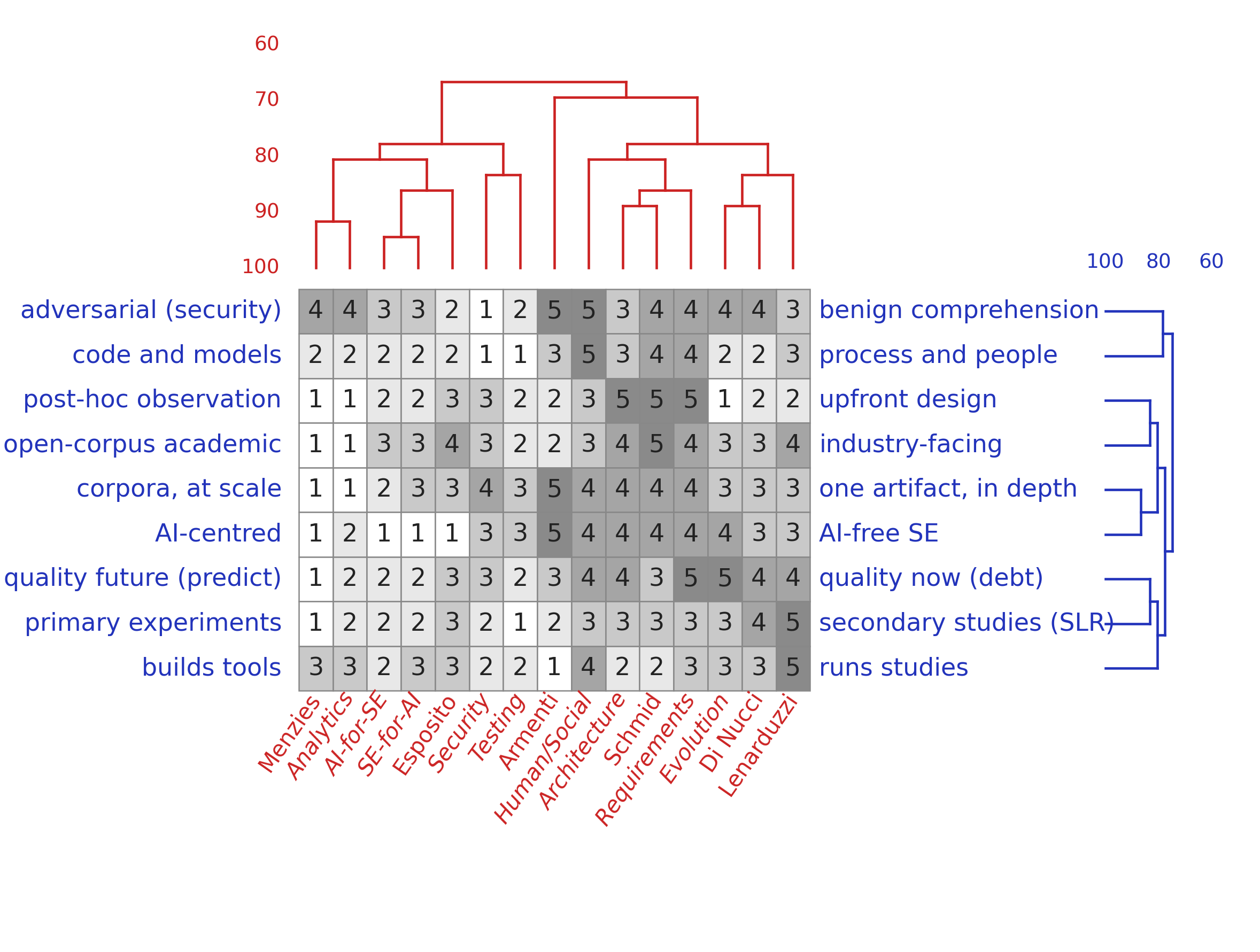
An example: a repertory grid showing the overlap of authors' research areas and a field's topic areas. LLMs can generate such grids automatically, in a minute or two. For more, see 1 and 2.
Have strengths — but where should you aim them?
Map team to field —
score the venue's areas on the same grid as the people. Centroid,
maximin, and blends nominate the topic; blind spots get priced.
Drowning in 10,000 search hits?
Read above the knee —
filter by venue inside the query, read above the citation knee,
snowball both directions, and treat the download rate as a finding.
Staring at a blank page?
Write to a grammar —
a paper parses under a small grammar: intro, lit review, methods,
threats, conclusion. Disagree? Edit the productions, regenerate the
sample; the experiment costs minutes.
Does your draft smell like AI slop?
Un-slop the prose —
keep the STE skeleton (short, active, one meaning per word); subtract
the engagement tells (hooks, applause paragraphs). Ship the ban list
as a linter, then rewrite the missing bridges by hand.
Want Reviewer 2's verdict before Reviewer 2 gets it?
Assemble critics —
an LLM plays Reviewer 2 using the venue's own review criteria; a
triage prompt splits findings into machine fixes and human decisions.
Afraid the machine will run away with your paper?
Pause and reflect —
every computed step ends in a boxed call-out: the questions a reviewer
should ask, and the exact knob to edit so the rest follows the human,
not the machine.
Will your claims survive an audit?
Keep the receipts —
every citation carries a clickable DOI; claims wait for their
statistics (significance + effect size); the conclusion retells the
intro with numbers attached; title and abstract must recode with zero
flips.
Just want words to paste?
✎ Sample prompts —
the triad interview, the lit search, the STE rewrite (with permission
for the occasional flourish), learn-a-grammar, Reviewer 2, triage,
the zero-flip gate.
Mastered the eight? Make your own.
★ Advanced tricks —
don't write a grammar, learn one from papers you admire;
venue-tune it; parse drafts against it; learn the anti-grammar from
slop.
Engine: github.com/timm/rite. Comments to timm@ieee.org.